
Maryland Heights City Directory Collections
Maryland Heights is in St. Louis County, so the useful historical shelf is the county directory collection rather than a run that claims to be a municipal directory for the present-day city. St. Louis County Library reports an overall county-directory range of 1893 through 1979, with real gaps and changes in format. The library's holdings list names print and microfilm copies for selected years, while its Digital Archives provides a free remote route for available volumes. The official holdings text does not identify a publisher, so the publisher should remain unresolved instead of being supplied from another directory series.
| Collection | Years | Where Held | Access |
|---|---|---|---|
| St. Louis County directories | 1893-1979 overall range, with gaps | St. Louis County Library Digital Archives, print, and microfilm | Free online access where digitized; physical reference access for other volumes |
| Selected county holdings | Listed years from 1893 through 1979 | St. Louis County Library | Formats vary by year, including print, microfilm, or both |
| Reverse or criss-cross sections | Run-specific; a reverse section is noted in a 1922 city directory | Library directory volumes | Inspect the particular volume before relying on an address section |
| Companion local-history material | Title-specific and collection-specific | History and Genealogy collection and Digital Archives | Remote, onsite, or lookup-service access depending on the item |
The library's Missouri, St. Louis City, and County holdings page is the source for the selected year and format list.
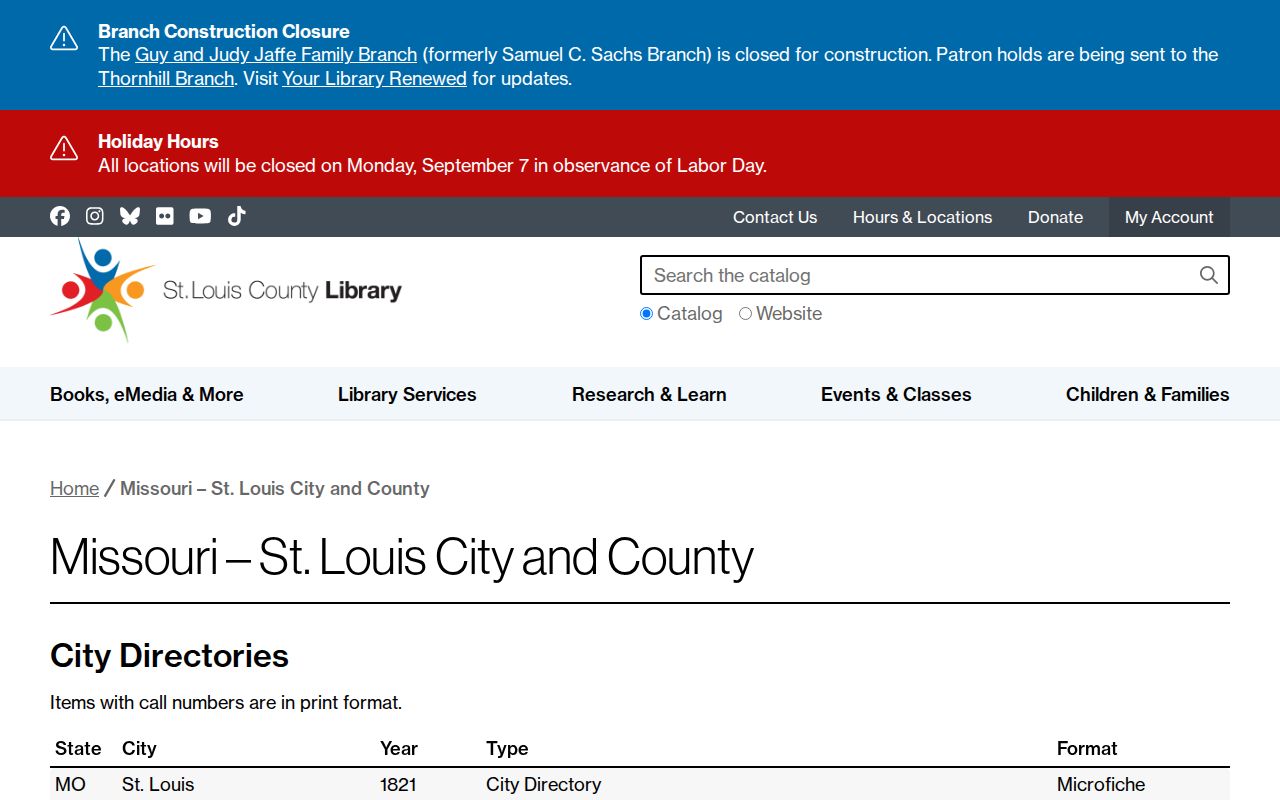
Check that list before planning a search, because a date between the listed volumes is not evidence of continuous county coverage.
Maryland Heights County Directory Years
The exact county holdings begin with 1893 on microfilm, followed by 1896 in print, 1903 in both forms, and 1909 on microfilm. The library then lists 1917, 1920, 1922, and 1923; a group of 1930s and 1940s volumes; selected 1950s volumes; 1961; many volumes from 1962 through 1976; and 1979. Several listed years have both print and microfilm, but the format is not uniform. These are county holdings and should not be treated as proof that every Maryland Heights household appears in every listed book.
When a needed year is absent, use the nearest earlier and later available directories, then test the interval with a deed transfer, a dated newspaper item, a tax record, or a library reference request. That method preserves the gap instead of filling it with an assumption. A missing name can reflect a move, a listing choice, a spelling change, a missing page, or a volume that simply did not cover the person sought.
| 1893, 1896, 1903, 1909 | 1893 and 1909 are listed on microfilm; 1896 is print; 1903 has microfilm and print. |
|---|---|
| 1917, 1920, 1922, 1923 | All are listed on microfilm; 1917, 1920, and 1922 also have print copies. |
| 1930, 1932, 1934, 1936, 1938, 1939, 1941, 1943, 1946, 1949 | Listed in both microfilm and print. |
| 1953, 1955, 1957, 1958, 1959; 1961 | The 1950s entries are listed in both formats; 1961 is listed on microfilm. |
| 1962, 1963, 1965-1971, 1972-73, 1973-1976, 1979 | Listed in both microfilm and print, except for the separately noted 1961 volume. |
Maryland Heights City Directories Online
The county-directory route starts at St. Louis County Library's directory page and continues into Digital Archives. No library card is required for that remote collection. Choose the St. Louis County Directories collection, select a year, and then choose the surname-letter section. A name or part of an address may be searchable, but the library advises browsing the alphabetical pages to verify a result because OCR can miss printed text.
St. Louis County Directories shows the library's browse path into the digitized volumes.
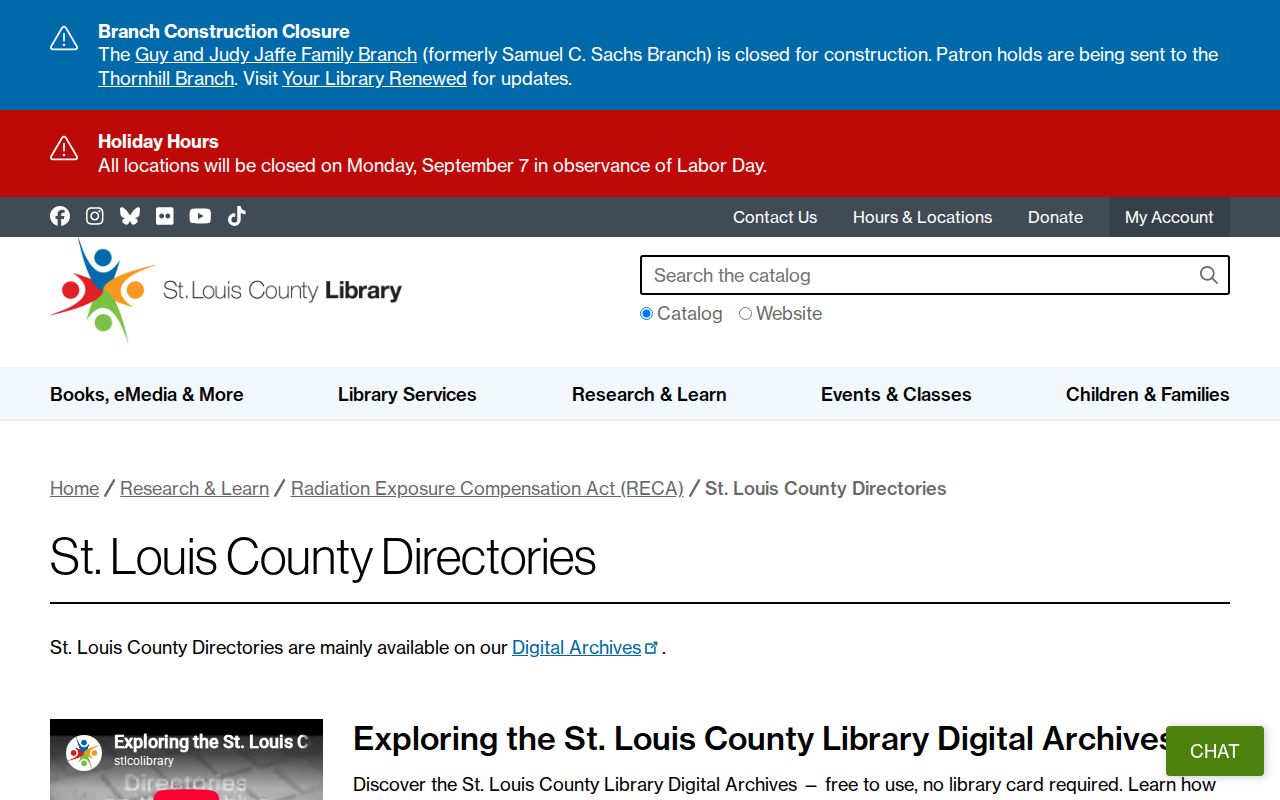
Viewing the page before and after a hit helps catch a split surname, a heading change, or a listing that the search index did not read well.
The Digital Archives expanded public access in a March 11, 2024 library announcement. It includes directories alongside yearbooks, newspapers, burial certificates, maps, and atlases. A February 2025 update added 1881-1889 issues of the Watchman-Advocate, a separate dated source that can add context to a historical name search.
Reading a Maryland Heights City Directory Entry
A city directory entry should be transcribed as printed. The Digital Archives guide uses a 1938 alphabetic example for a surname beginning with Stroup, but the text-only research did not establish every mark visible in that scan. Record only fields that appear in the chosen volume: the printed name, address, relationship notation, affiliation notation, owner or renter notation if present, telephone line, abbreviations, page, and year. Keep initials, street suffixes, and spelling rather than silently converting them to modern forms.
| Printed name | Capture the surname, initials, suffix, and spelling exactly as the volume gives them. |
|---|---|
| Relationship notation | A spouse or widow notation can appear, but only preserve it when it is printed. |
| Occupation or affiliation | Some entries include an occupation or other affiliation notation; do not infer one where the entry is silent. |
| Address and line context | Note the house number, street, page, year, and nearby entry context. |
| Marks and abbreviations | Use the volume's own key before expanding a mark for owner, renter, widow, or telephone information. |
The St. Louis sources guide places directory research alongside county land, court, newspaper, church, and cemetery paths.
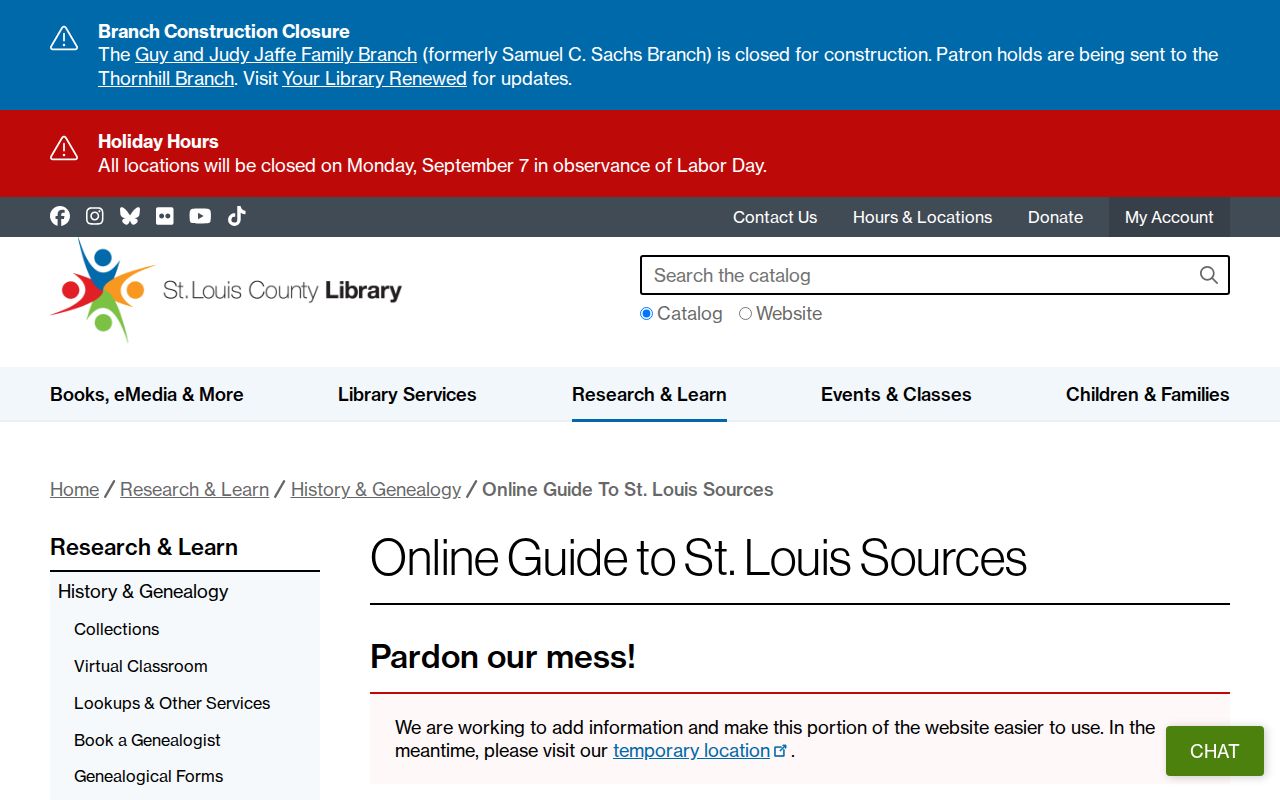
A directory entry is strongest when its date and page travel with any follow-up search in another collection.
- Criss-cross section
- An address-ordered part of a directory that may connect a street number to a listed occupant. It is not known to be present in every volume.
- Householder index
- An alphabetical arrangement intended to help locate the named person or household entry before checking the printed listing.
- Abbreviation key
- The volume's explanation of its shortened terms and marks. Photograph or transcribe it before expanding a notation.
Reverse Directory Checks for Maryland Heights
Address-first searching changes the question. A reverse or criss-cross section can connect a historic address to an occupant where that section exists, while the alphabetic pages start with the name. Library material notes that a reverse directory first appeared in the back of a 1922 city directory. That is a useful lead, not a promise that each later county directory has a reverse section or uses the same arrangement.
Open the selected year and verify the section itself. If an address appears, retain the printed street number and abbreviation, then compare it with the alphabetic listing and a nearby volume. For a current parcel path, the Maryland Heights by-street directory follows the modern assessor, GIS, and Recorder sequence instead of treating an old listing as present-day proof.
Tracing a Maryland Heights Household
Historical directories make useful checkpoints between federal censuses. Use the closest available directory, then work to the next available volume rather than assuming the library has a book for every intervening year. A census household and a directory listing answer different questions, so compare the address, the source date, and the relationship each record actually shows.
- Locate the person or address in the nearest available county directory and record the page, printed spelling, and street form.
- Check the preceding and following available directory volumes for a move, notation change, or absence.
- Use a federal census checkpoint only after the 72-year public-release interval has passed, and retain the census date with the result.
- Compare the directory date with a deed transfer, assessor evidence, newspaper citation, church or cemetery source, or a public probate record.
- Describe the conclusion narrowly, such as a dated address clue, rather than declaring a complete household history from one listing.
County and City Directory Trails
Late 1876 separated St. Louis City and St. Louis County into distinct governmental and record trails. The library's local-source guide calls that split essential. County directories can therefore be the better first search for a Maryland Heights question, while an older event described broadly as St. Louis may require the city collection as well. Do not combine the city directory ranges with the county holdings list.
Maryland Heights incorporated in 1985. Earlier names and addresses may appear under a county, community, subdivision, or rural-route label rather than under the modern city name. A legal description or period map can bridge a current place name to the older wording without rewriting the historical record.
Library Support for Maryland Heights Research
St. Louis County Library's Emerson History and Genealogy Center is a substantial companion to the digitized directory shelf. Library educational material describes more than 100,000 cataloged local-history and genealogy items, including directories, newspapers, school publications, maps, cemetery and church material, court and will resources, and local-history files. The library also identifies county court indexes for 1824-1861, county deed material for 1877-1931, and a property-ownership index for 1974-1992. These are separate series, not city-directory labels, and each can test a directory lead with a different date and purpose.
The History and Genealogy collection page describes the physical and digital collection categories.
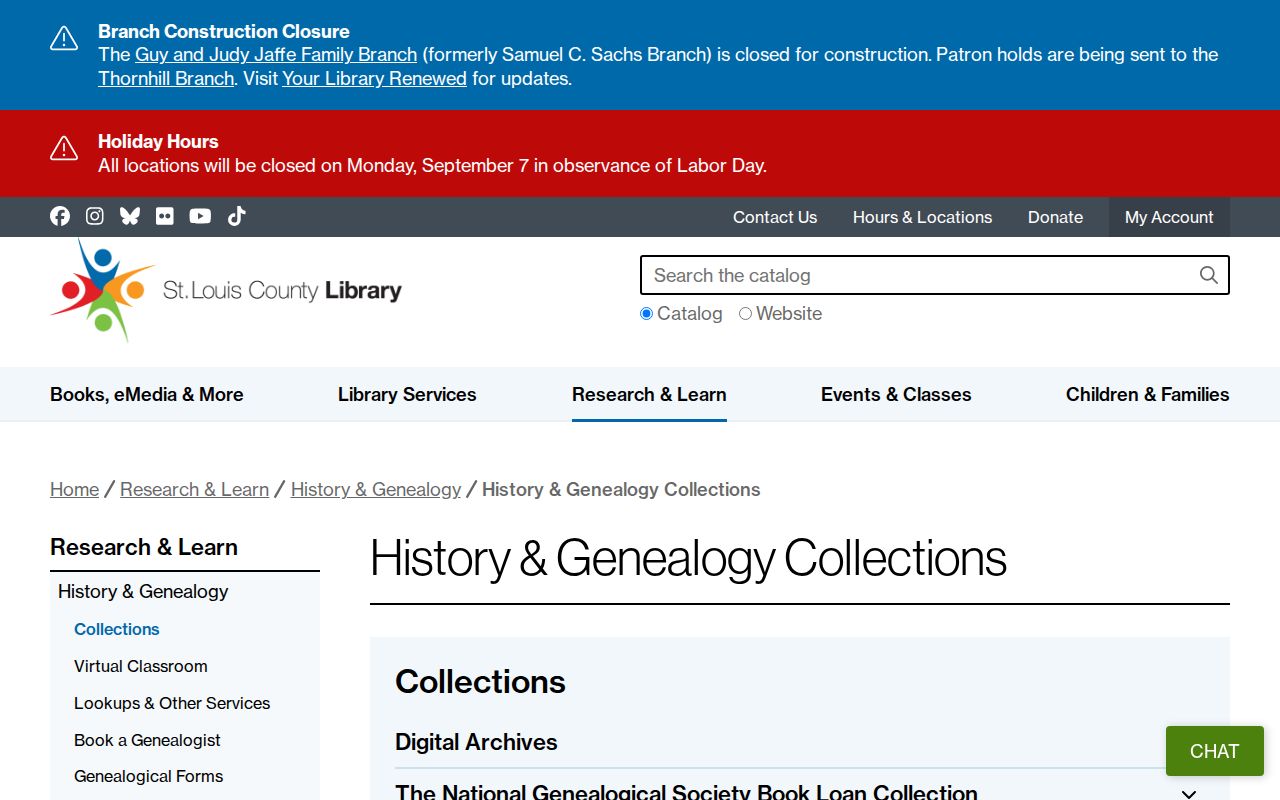
Directories, maps, newspapers, and cemetery material can each supply a distinct dated clue, rather than a substitute for one another.
Maryland Heights Directory Lookup Requests
The library offers free lookups in indexed sources and can send scans when a request identifies an exact source. Give the collection, year, name, and citation whenever possible. The service limits a mailing to three searches. Obituary requests need an exact death date and citation, while fragile paper directories may not be photocopied. Those limits make a carefully recorded directory page especially useful.
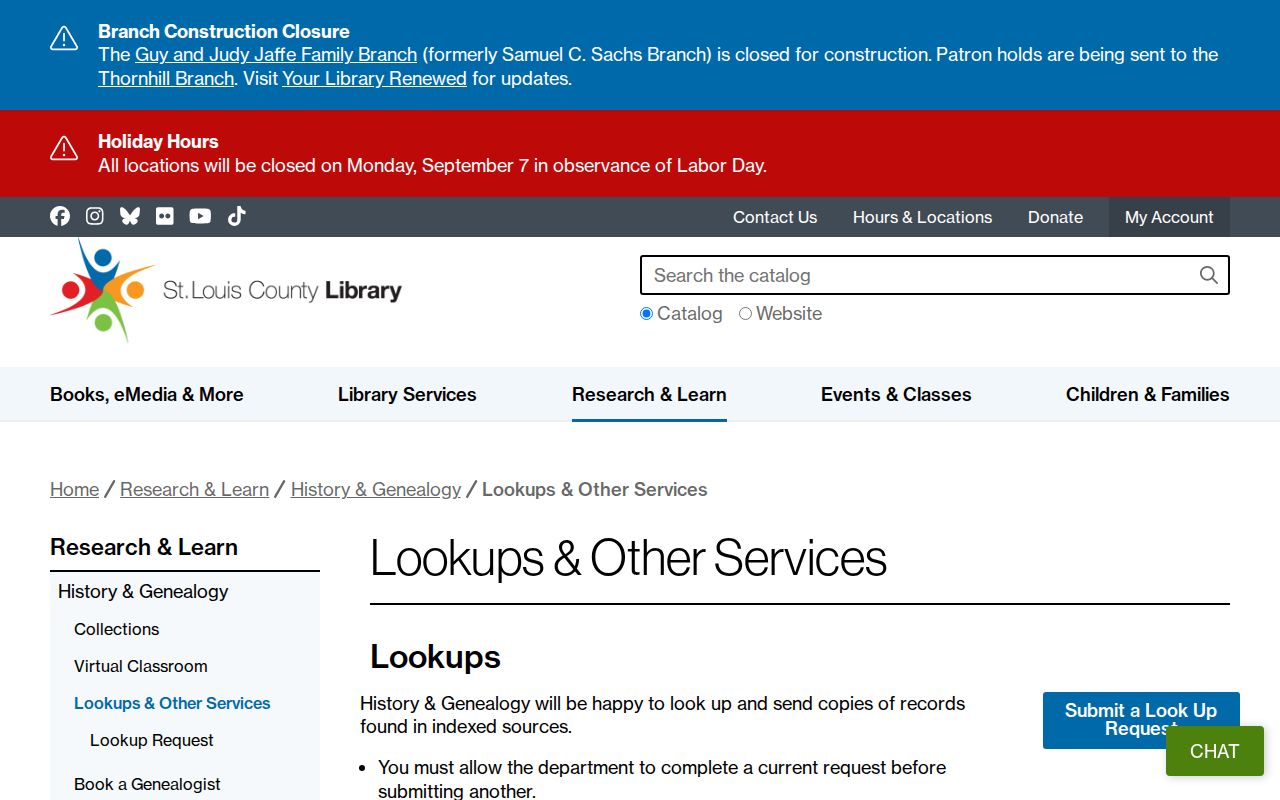
History and Genealogy lookups explains the library's request and scan practices.
When a fragile volume cannot be copied, retain the exact citation and ask the library what reference help remains available for that item. The library's PastPorts index is also useful for dated collection updates and local-history research notices.